Owe the SAT? How Foreigners in Mexico Can Erase Penalties
SAT penalties: how foreigners living in Mexico can erase 100% of them in 2027
Many foreigners who live in Mexico find out they owe the SAT the hard way: a letter in the buzón tributario, a bank asking for a tax certificate, or a notary who won’t close a property sale. By then, the original tax is rarely the biggest number. Surcharges (recargos) grow every month, and the penalty for not paying on time can match or exceed the tax itself.For 2027, Mexico’s Federal Revenue Law includes a program that waives 100% of penalties, surcharges and collection costs for anyone who pays the tax they owe. It is open to individuals as well as companies, with no income limit.Here is who qualifies, what you still have to pay, the dates that matter, and how to prepare if you are a foreigner living in Mexico.
What the 2027 program does
The program is a tax incentive included in the Twenty-First Transitory Article of the Federal Revenue Law for 2027 (Ley de Ingresos de la Federación). Congress approved it in October 2026, and it is pending publication in the Diario Oficial de la Federación (DOF), Mexico’s official gazette.Be precise about what it is: it is not a tax amnesty that forgives the tax. You pay the unpaid tax in full, adjusted for inflation. What disappears are the extra charges: penalties, surcharges and collection costs.
Are you a Mexican tax resident?
This is the first question, because it defines what you owe. Many foreigners assume the “183-day rule” decides it. For individuals, Mexico’s Federal Tax Code does not work that way. Under Article 9, you are a Mexican tax resident if you have your home in Mexico. If you also have a home in another country, the deciding factor is where your center of vital interests is: mainly, where most of your income comes from or where your main professional activity is.The consequence is serious. Mexican tax residents pay tax on their worldwide income, not only on what they earn in Mexico. A retiree with a home in Mérida or San Miguel de Allende and a pension from abroad may have obligations with the SAT, even if they never worked for a Mexican employer. Tax treaties can change the final result, but they do not remove the need to file.If you have unpaid taxes in Mexico, this is exactly the kind of debt the 2027 program was designed for.
Who can apply
Individuals and companies with tax debts managed by the SAT, with no income limit. That includes foreigners who:
- Are tax residents in Mexico and did not file or pay on time.Have an RFC (Mexican taxpayer ID) and income from rentals, services or a business in Mexico.Already used the 2025 or 2026 program. According to the initiative, having used a previous program no longer disqualifies you.
The debts can be income tax (ISR), VAT (IVA), withholdings, and certain other charges managed by the SAT or Mexico’s customs agency.
What is waived and what is not
| ConceptWaived? | Surcharges (recargos)Yes, 100%Penalties for late or missed paymentYes, 100%Collection costs (gastos de ejecución)Yes, 100%Unpaid taxNo. Paid in fullInflation adjustmentNo. Paid in full |
|---|
There is one special case. If the debt is a final assessment made up only of penalties for formal obligations (for example, not filing a notice or an informational return), the initiative provides a 90% reduction of the penalty, as long as you first comply with the missing obligation.
A worked example
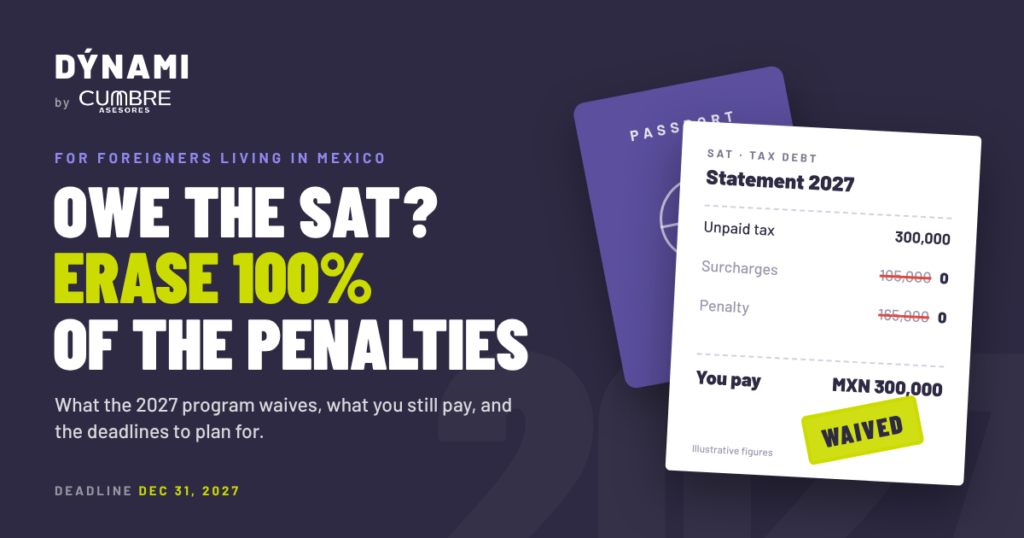
Imagine a foreign resident who sold a condo in 2023 and did not pay the income tax on the gain. Figures are rounded and only illustrate the calculation.
| ConceptWithout the programWith the program | Unpaid tax, inflation-adjustedMXN 300,000MXN 300,000Accumulated surchargesMXN 105,000MXN 0PenaltyMXN 165,000MXN 0Total to payMXN 570,000MXN 300,000 |
|---|
In this case, the savings are close to half the total debt. The longer a debt stays open, the more surcharges weigh and the bigger the benefit.
Common cases among foreigners
These are the situations we see most often:
- Rental income that was never reported. A house or apartment rented to tourists or long-term tenants generates taxable income in Mexico.Property sales without the right tax treatment. Not every sale is exempt. When the exemption does not apply or was not documented correctly, the tax can show up years later.Freelance or consulting work done from Mexico. For a tax resident, that income is taxable in Mexico, even if the client pays into a foreign account.A small business with incomplete filings. Restaurants, property management and tourism services run by foreigners often carry gaps in monthly returns.Residents who never filed an annual return because they believed only Mexican-source salaries were taxable.
The program covers debts from 2025 or earlier, as long as you file the corresponding returns. It also covers SAT audits already in progress if you self-correct within that audit’s deadlines, and final assessments if you withdraw any legal challenge.
If you run a business in Mexico, this is where DÝNAMI by Cumbre Asesores comes in. Many foreign owners spend part of the year abroad and rely on a local bookkeeper’s word that everything is in order. DÝNAMI sends real-time alerts when documentation expires, when an operation has no supporting evidence, or when a supplier appears on an SAT list. You see the problem when it starts, not when it has already become a penalty. See how DÝNAMI works.
The deadlines that matter
| DateWhat happens | January 1, 2027The program takes effect (once published in the DOF)October 31, 2027Deadline to apply for the benefit on final assessmentsDecember 31, 2027Deadline to pay debts from 2025 or earlier and to self-correct during audits in progress |
|---|
Two conditions to keep in mind:
- Payment is a single lump sum. The initiative does not allow installments, payment in kind or offsetting against refunds. Plan your cash flow, especially if your money is abroad and needs to be transferred.Deadlines on final assessments are short. Once you apply, the SAT issues a payment form and you have 15 calendar days to pay it.
Waiting until December 2027 is a mistake. Gathering old bank statements, rental contracts and deeds takes time, and even more so if some documents are in another country.
Who is left out
The program keeps important exclusions:
- Taxpayers facing criminal tax proceedings: with a criminal complaint and an arrest warrant, formally charged, or with a final conviction.Taxpayers published on the SAT’s definitive lists under Articles 49 Bis, 69-B or 69-B Bis of the Federal Tax Code, the so-called blacklist of companies that issue invoices for simulated operations. To understand how a business ends up there, read our guide to the SAT blacklist.Certain cases under Article 79 of the Income Tax Law and some public entities.
A key idea for foreign business owners: the program forgives the past, but it does not protect the future. If you clear your 2025 debts and keep buying from a supplier who is later listed by the SAT, you can end up with a new problem in 2027. DÝNAMI checks SAT lists continuously, so you can act before a supplier becomes your liability.
How to prepare now
- Confirm your tax residency status. Everything else depends on it.Check your SAT status. Review your buzón tributario, your compliance opinion (opinión de cumplimiento) and any notices. If you do not have an e.firma, get one.List every source of income in Mexico and abroad since you became a resident: rentals, sales, services, pensions.Separate your debts by type. Debts from 2025 or earlier, audits in progress and final assessments have different deadlines.Calculate what you will actually pay: unpaid tax plus inflation adjustment.Plan the transfer. If the money is abroad, account for transfer times and the exchange rate.Wait for the DOF publication and the SAT rules before filing anything. The procedure may be refined in the 2027 Miscellaneous Tax Resolution.Coordinate with your home-country advisor. This program only affects your obligations in Mexico. It does not change what you owe or must report in your country of origin.
Not sure whether your debts qualify or how much you would save? At Cumbre Asesores, we review your case, calculate both scenarios, and tell you whether joining the program makes sense. Schedule a review.
Frequently asked questions
Does the SAT forgive the tax I owe?No. The program waives penalties, surcharges and collection costs. You still pay the unpaid tax and its inflation adjustment in full.Can foreigners apply?Yes. The program applies to any taxpayer with debts managed by the SAT. Nationality is not a requirement; what matters is that the debt qualifies and you meet the conditions.I spend less than 183 days a year in Mexico. Am I safe?Not necessarily. For individuals, Mexican tax residency depends mainly on having your home in Mexico and, if you have homes in more than one country, on where your center of vital interests is.Can I pay in installments?According to the approved initiative, no. Payment is a single lump sum. Check whether the SAT rules open any other option.If I used the 2025 or 2026 program, can I apply again?Yes. The initiative no longer excludes taxpayers who used previous programs.Does this affect my taxes in the United States, Canada or Europe?No. The program only covers debts with Mexico’s SAT. Your obligations in your home country stay the same.When can I apply?Starting January 1, 2027, once the law is published in the DOF. Deadlines are October 31, 2027 for final assessments and December 31, 2027 for paying other debts.This article is based on the text approved by Mexico’s Congress as of November 7, 2026, and is subject to what is published in the Diario Oficial de la Federación and the rules issued by the SAT. It does not replace personalized tax advice.