Nvidia Scandal & U.S. Ground Stop: 2 Compliance Lessons
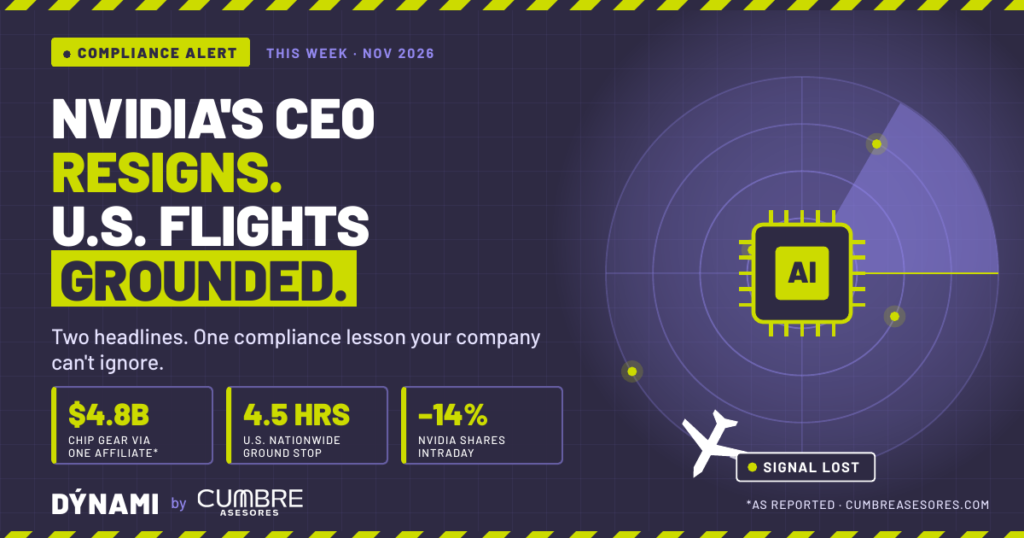
In the same week, two very different stories dominated the U.S. news cycle. On November 12, 2026, Nvidia, the world’s most valuable chipmaker, announced that Jensen Huang had resigned as CEO, effective immediately, amid reports that he had been targeted by a suspected Chinese intelligence operation. The next afternoon, the Federal Aviation Administration (FAA) halted every departure in the country for about four and a half hours after a communications failure hit its air traffic control centers.
One is a corporate scandal; the other, an infrastructure breakdown. For compliance teams, they teach the same lesson: the risk that hurts you is the one you never documented, whether it is a counterparty nobody looked at closely enough or a system nobody expected to fail.
What happened at Nvidia
- November 8. Huang acknowledged an extramarital relationship and apologized to employees. Nvidia’s board expressed confidence in him and opened an independent investigation into reports that he had been targeted by Chinese intelligence.
- The counterparty. Reporting centered on Alice Huang (no relation), also known as Huang Le, a former executive of Megaspeed, a Singapore-based data center operator that bought Nvidia hardware. U.S. officials had reportedly placed her under surveillance on suspicion of chip smuggling and concluded she was a Chinese intelligence asset.
- A second issue. Further reports described a relationship with Kimberly Powell, a senior executive who reported directly to Huang, raising a separate conflict-of-interest question.
- November 12. In a filing with the U.S. Securities and Exchange Commission, Nvidia announced that Huang had resigned as president, CEO and board member. CFO Colette Kress became interim CEO, and Harvey C. Jones was named the company’s first-ever Chair of the Board. The filing gave no reason. Shares fell more than 14% at one point that day before recovering part of the loss.
What has not been proven matters just as much. Allegations of illegal shipments through Megaspeed have not been publicly substantiated, and there is no established evidence that Huang knowingly helped Beijing or that company secrets were compromised. China’s Foreign Ministry dismissed the reports, and Nvidia says it reviewed how its GPUs were deployed to rule out diversion.
Red flags hidden in plain sight
Set the espionage angle aside. The Megaspeed file, as reported, reads like a training case in counterparty risk:
- Volume without history. Megaspeed began buying chips in 2024 with no visible track record in the sector. A Malaysian affiliate purchased at least $4.8 billion in equipment incorporating Nvidia technology between June 2024 and February 2026.
- A changed identity. Before it was Megaspeed, the company was 7Road International, a subsidiary of Chinese video game developer 7Road Holdings.
- Layered jurisdictions. A Singapore operator, a Malaysian affiliate and end users under question: every hop makes the final destination harder to see.
- Owner and user are not the same. Megaspeed’s model, buying GPUs and selling computing capacity remotely, means whoever holds the hardware and whoever actually uses it can be different parties.
- Access at the top. When a counterparty’s executive has a personal line to your CEO, the relationship is no longer purely commercial.
None of these proves wrongdoing. Each one is a reason to ask questions, and to keep a written record of the answers.
Lesson 1: know who you sell to
Nvidia’s position, in essence, has been “we checked.” Perhaps it did. But when a regulator, an investor or a board asks, “we checked” is only as strong as the file behind it: who reviewed the counterparty, when, against which lists, what they found and who signed off.
Mexico’s anti-money laundering framework is moving in the same direction. The reform to the Federal Law for the Prevention and Identification of Operations with Resources of Illicit Origin (LFPIORPI) was published in the Official Gazette (DOF) on July 16, 2025, and its Regulations on March 27, 2026. Acuerdo 115/2026 (DOF, August 7, 2026) puts the Article 41 automated monitoring requirements into operation, with key deadlines on March 1 and June 1, 2027. For companies carrying out vulnerable activities, the question is shifting from whether you know your client to whether you can prove it.
The Powell episode adds a governance point: reporting lines and personal relationships between executives are disclosure items, not private matters, once they can influence a business decision.
DÝNAMI by Cumbre Asesores keeps that file in one place: identification of clients and suppliers, beneficial-owner records, list checks against sanctions lists and the SAT’s (Mexico’s Tax Administration Service) published lists, and a timestamped audit trail of every review.
What grounded U.S. airspace
On Friday, November 13, Transportation Secretary Sean Duffy said radar and communications instability began at 3:36 p.m. ET. The FAA issued a nationwide ground stop minutes later and lifted it at 8:15 p.m. More than 3,500 aircraft were airborne when the order went out.
It was only the second nationwide ground stop since 9/11; the previous one, in 2023, was traced to a corrupted file in a system that sends notices to pilots. This time, Duffy blamed outdated routers and decades-old technology, said “the system got overloaded,” and asked Congress for $50 billion in emergency funding to overhaul air traffic control. The FAA has not ruled out a cyberattack, although senior officials said they do not believe it was one. The investigation is at an early stage, and the official explanation may change.
Lesson 2: compliance can’t go dark
The FAA did what a well-run operation should: stop, account for every aircraft and restart. The underlying problem, aging infrastructure with single points of failure, was known long before Friday.
Most compliance programs have their own version of an old router: the spreadsheet only one analyst understands, the shared inbox where supplier files arrive, the officer who holds every password. When that piece fails, monitoring stops, but obligations do not. An alert missed during an outage is still a missed alert in an audit.
Three questions worth asking this week:
- Where does your evidence actually live, and who can retrieve it?
- If your compliance officer left tomorrow, could someone reconstruct last quarter’s reviews?
- Do alerts still fire, and get read, when the person responsible is out?
DÝNAMI by Cumbre Asesores replaces scattered files with a single traceable record and sends real-time alerts when documentation expires, a transaction lacks supporting evidence or a supplier appears on an SAT list, so your program does not depend on one person’s memory.
Key-person risk: the shared thread
The two stories meet at one point. Nvidia’s board had a plan within hours: the CFO stepped in as interim CEO and a new chair took over the board. That is succession planning working under pressure. The FAA, by contrast, showed what happens when critical operations rest on components nobody has replaced in decades.
Apply the same test to your compliance function: who takes over, with what access and from which records.
A 5-point checklist for this week
- List your top 20 counterparties by volume and confirm each has a current beneficial-owner record.
- Flag any client or supplier whose volume jumped with no operating history to explain it.
- Map the intermediaries and jurisdictions between you and the final user.
- Confirm every review leaves a dated, signed record you can retrieve without the person who did it.
- Name a backup for your compliance officer and test whether they can complete a review alone.
Frequently asked questions
Why did Jensen Huang resign from Nvidia? Nvidia’s SEC filing did not give a reason. The resignation followed reports of extramarital relationships, including one with a businesswoman whom U.S. officials reportedly suspect of working for Chinese intelligence, and an independent investigation opened by the board. There is no established evidence that he knowingly assisted Beijing.
What is third-party due diligence? It is the process of verifying who your clients, suppliers and intermediaries are, who ultimately controls them and whether they appear on sanctions or tax authority lists, and of keeping documented evidence of each review.
What caused the U.S. nationwide ground stop on November 13, 2026? Officials attributed it to a communications failure affecting multiple air route traffic control centers, and the Transportation Secretary blamed outdated equipment. The FAA’s investigation is ongoing.
Do these lessons apply to companies operating in Mexico? Yes. Mexico’s anti-money laundering framework requires companies carrying out vulnerable activities to identify their clients and keep supporting evidence, and Acuerdo 115/2026 sets compliance deadlines in March and June 2027 for automated monitoring.
What is key-person risk in compliance? It is the exposure created when a program depends on a single person, system or file. If that piece is unavailable, monitoring stops and the evidence trail breaks.