False Invoices in Mexico
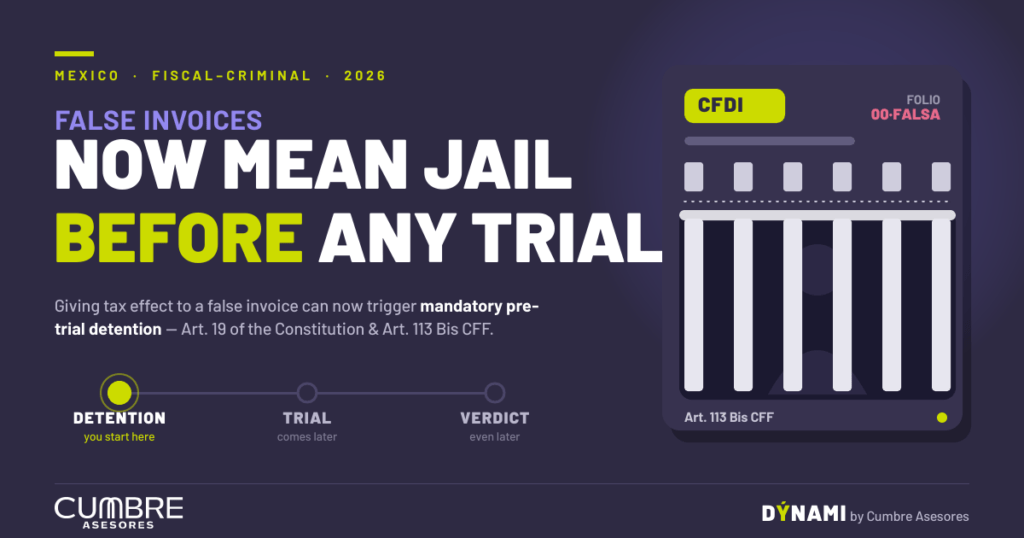
Imagine your Mexican subsidiary received a CFDI (a Mexican digital tax receipt), deducted it, and then, months later, the tax authority — the SAT — published that supplier on its Article 69-B blacklist. Until recently, this was merely a money problem: a rejected deduction, a tax assessment, a penalty. Since 2025, however, it can be far more serious. In fact, the exposure around false invoices in Mexico no longer waits for a verdict. For certain cases, the law now orders mandatory pre-trial detention — that is, facing the entire criminal process from a cell, before any sentence exists. Moreover, as of November 7, 2025, the offense reaches the party that gives tax effect to a false receipt: not only the company that sells the invoice, but also the company that uses it. As a result, for foreign groups operating through a Mexican entity, the local legal representatives and directors are the ones personally exposed. Below, therefore, we explain what changed, what did not, and where the real risk sits.
What is pre-trial detention?
Mandatory pre-trial detention (prisión preventiva oficiosa) is a precautionary measure, not a punishment. Specifically, a judge orders it automatically, and the accused waits for the process in prison even though no sentence has been handed down. For readers used to common-law systems, therefore, this is the jarring part: detention runs during the process, not after conviction. Because of its severity, however, it applies only to the offenses that Mexico’s Constitution itself lists in Article 19. In short, nothing outside that list qualifies.
The 2019 attempt and the Court
Back in 2019, an earlier effort tried to pull tax offenses — fraud, smuggling and false invoicing — into this regime through the back door, that is, by treating them as organized crime and threats to national security. However, Mexico’s Supreme Court, ruling on constitutional challenge 130/2019 and its consolidated case 136/2019, struck that equivalence down (judgment published in the Federal Official Gazette on August 20, 2025): a tax offense is not, by itself, organized crime. The Court did, nonetheless, uphold the validity of Article 113 Bis of the Federal Tax Code (CFF). In other words, the false-invoicing offense remains fully alive. Furthermore, it set a decisive rule: only a constitutional amendment can expand the pre-trial-detention list, never the ordinary legislature.
What changed in 2024 and 2025
That is exactly what happened next. First, on December 31, 2024, Article 19 of the Constitution was amended to add “any activity related to false tax receipts, on the terms set by law,” in force since January 1, 2025. In addition, the amendment expressly bars reading it either broadly or narrowly. Then, on November 7, 2025, the CFF was reformed to harmonize with it: Article 113 Bis keeps its two-to-nine-year prison penalty and now also sanctions whoever gives tax effect to a false receipt. Moreover, the same package added express CFDI-verification powers for the authority (Articles 29-A Bis and 49 Bis) and denial of tax-registry (RFC) enrollment for legal entities tied to EFOS or EDOS.
This is not tax fraud
Here is the precision almost no one gets right. Notably, tax fraud (defraudación fiscal) was left out of the list — indeed, it was expressly removed during the legislative process. Instead, what triggers mandatory pre-trial detention is activity related to false tax receipts — Article 113 Bis — not tax fraud in general. Consequently, blurring the two leads to two costly mistakes: panicking over what does not apply and, worse, neglecting what does.
Now it reaches the buyer too
For years, “invoice mill” meant the party that sells receipts: the EFOS (a company that issues invoices for simulated operations). However, the November 7, 2025 reform closed the other side. As a result, the offense is now also committed by whoever buys, acquires or gives tax effect to those receipts: the EDOS (a company that deducts or credits simulated operations) — that is, the business that took the deduction or credited the VAT using a simulated invoice. In plain terms, therefore, using a false invoice — not only selling it — now falls squarely within the criminal offense.
Still, one nuance both protects and obligates: the offense requires intent (dolo) — doing it knowingly. For instance, receiving in good faith a CFDI that later turns out to be false is not, in itself, a crime. Rather, the problem is evidentiary. In other words, if you cannot demonstrate your good faith — that you screened the supplier and that the operation genuinely happened — you are exposed. This is precisely where DÝNAMI by Cumbre Asesores works ahead of the problem: it keeps SAT-list screening current and, in addition, flags operations without support, so your Mexican entity never gives tax effect to a receipt that puts it in the crosshairs.
The link to the 69-B list
The bridge between the tax world and the criminal one is the Article 69-B blacklist. Specifically, when the SAT publishes a supplier as a definitive EFOS, that supplier’s CFDIs lose all tax effect unless you can prove materiality or correct within the deadline. As a result, that finding — once purely fiscal — can now be the seed of a criminal file if it is argued that you knowingly gave effect to a simulated receipt. That is why, ultimately, the defense is built before, not after: with continuous list screening and a materiality file assembled from the moment you operate, rather than when the audit arrives.
How to stay off the criminal track
Three things, in order. First, screen suppliers against the SAT lists — 69-B and others — continuously, not just at onboarding. Second, keep a materiality file per operation: that is, contract, deliverables and evidence that the good or service actually existed. Third, ensure traceability: every check logged with a date, so that you can prove good faith if anyone questions it.
DÝNAMI by Cumbre Asesores, meanwhile, does all three automatically: it monitors in real time whether a supplier appears on the SAT lists, flags operations without documentary support, and leaves the auditable trail that sustains your good faith. In the end, it is not one more formality. On the contrary, it is the difference between a routine clarification and a criminal investigation — a distinction that matters even more when the exposed individuals sit inside a foreign group’s Mexican operation.
Frequently asked questions
Does a false invoice mean automatic jail in Mexico?
No. Mandatory pre-trial detention operates within a criminal process already opened for the Article 113 Bis offense. Moreover, it requires the prosecutor to establish the conduct and secure a binding-over to trial. In short, it is not a penalty that turns into prison on its own.
Does tax fraud also carry mandatory pre-trial detention?
Not directly, because it was excluded from the constitutional list. It could only reach that measure, however, if established together with organized crime or money laundering, which are separate offenses.
We received an invoice in good faith that turned out false. Are we liable?
The offense requires intent. Therefore, if you acted in good faith and can prove it — you screened the supplier and the operation existed — no offense is committed. In practice, the real risk is not bad faith; rather, it is being unable to prove the good faith.
What is the difference between an EFOS and an EDOS?
The EFOS issues receipts for nonexistent operations, whereas the EDOS uses them to deduct or credit. Furthermore, since November 2025, giving tax effect to those receipts is also criminally sanctioned.
Is a false invoice organized crime in Mexico?
Not by itself. Indeed, the Supreme Court struck that equivalence down when it resolved challenge 130/2019. Instead, it is a standalone Article 113 Bis offense; organized crime, meanwhile, requires its own distinct elements.
This content is informational and does not constitute tax, legal or compliance advice for a specific case. The application of Article 113 Bis of the CFF, Article 19 of the Constitution, and the 2024 and 2025 reforms depends on the specific circumstances of each operation. For a particular analysis, consult a professional.