Mexico 2027 tax reform
Mexico 2027: No New Taxes. Just Fewer Deductions.
On September 8, 2026, Mexico’s Executive sent its 2027 Economic Package to Congress. The headline sounds reassuring: no new taxes and no increase in the 30% corporate income tax rate.
Read past the headline, though, and the message for foreign-owned subsidiaries is different. The bill would cap how much a company can deduct in a year, limit how fast it can use prior losses, and tie cross-border payments to cash and withholding. In other words, the Mexico 2027 tax reform doesn’t raise the rate. It raises the base you pay it on.
Status as of October 2, 2026: this is a bill, not law. The Chamber of Deputies must approve the Federal Revenue Law by October 20 and the Senate by October 31. If enacted as proposed, most changes would take effect on January 1, 2027, including the calculation of monthly provisional payments. We will update this article once the final text is published in the Official Gazette (DOF).
The headline vs. the fine print
The government’s stated goal is to curb erosion of the tax base caused by heavy use of deductions and tax losses, and by simulated transactions involving invoice mills. To do that, the bill adds a new chapter to the Income Tax Law (LISR) titled Mechanism for the Control of Authorized Deductions and Tax Losses.
Mexico’s finance ministry expects the deduction cap alone to raise roughly MXN 140 billion. The money has to come from somewhere, and much of it would come from companies that report thin margins year after year.
Who is in scope
The control mechanism would apply to Mexican-resident legal entities with accruable income above MXN 50 million. It is not limited to Mexican-owned groups. A US, Canadian, European or Asian group’s Mexican subsidiary that crosses the threshold is fully in scope.
The bill excludes certain taxpayers, such as companies declared bankrupt under Mexico’s Commercial Insolvency Law. Treat the exclusion list as narrow until the final text confirms it.
A floor under your profit
This is the change most foreign groups will feel first. The bill sets two rules:
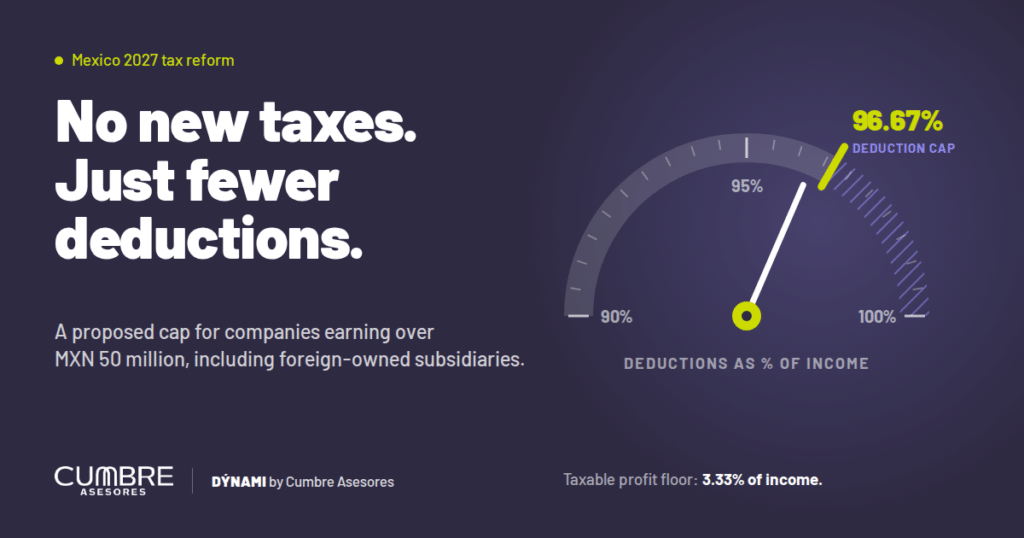
- If your deductions are at or below 96.67% of accruable income, you could claim 99% of them. A 1% haircut.
- If your deductions exceed 96.67%, they would be capped at 96.67% of income. In practice, your taxable profit could not fall below 3.33% of income, before losses.
Here is an illustrative case for a subsidiary with MXN 200 million in income:
| Scenario | Deductions | Current ISR (30%) | Proposed ISR | Difference |
|---|---|---|---|---|
| Thin margin | MXN 196 M (98%) | MXN 1.20 M | MXN 2.00 M | + MXN 0.80 M |
| Healthy margin | MXN 180 M (90%) | MXN 6.00 M | MXN 6.54 M | + MXN 0.54 M |
The thin-margin subsidiary pays about 67% more tax, with no change in its business.
Deductions above the cap would not be lost. Under the bill they could be carried forward for up to 20 years and must be tracked separately from tax losses.
The groups most exposed are those whose Mexican entity is designed to earn a small, stable margin. That includes low-risk distributors, cost-plus service companies and entities whose results depend on intercompany charges. A margin that works for transfer pricing could now sit below Mexico’s new floor.
Losses: half now, twenty years
Prior-year tax losses could only offset up to 50% of the year’s taxable profit, after the deduction cap is applied. In exchange, the carryforward period would be extended from 10 to 20 years.
Take a subsidiary with MXN 10 million in taxable profit and MXN 30 million in pending losses. Today it would pay no income tax that year. Under the proposal it could apply only MXN 5 million of losses and would pay ISR on the remaining MXN 5 million.
The losses are not lost; they are deferred. For a group that modeled its Mexican turnaround on using accumulated losses quickly, that deferral is real cash leaving the business in 2027.
Intercompany payments get a clock
For many foreign groups, this may be the quietest but most operational change. Payments to non-residents would only be deductible in the tax year in which they are actually paid and the corresponding withholding tax is remitted. For payments in foreign currency, conversion to pesos would be made at the time of withholding.
Royalties, management fees, technical services and interest charged by the parent are often accrued in Mexico and settled months later, or netted at year-end. Under the bill, an unpaid December invoice from headquarters would not be deductible in Mexico that year, no matter how solid its transfer pricing support.
Interest: from 30% to 20%
The general cap on net interest expense would drop from 30% to 20% of adjusted taxable profit. Subsidiaries funded mainly through intercompany debt should rerun their leverage models: interest that is deductible today may not be in 2027.
There is a lighter side: the package also includes a temporary 7.5% rate for repatriating foreign funds held as of September 8, 2026, if they return to Mexico by December 31, 2027 and stay invested for three years. It is mainly relevant for Mexican-resident taxpayers with assets abroad, not for most subsidiaries.
What to do before January
Waiting for the final text has a cost, because provisional payments could change from the first month of 2027. A practical pre-close agenda:
- Model 2027 at three margins. Run your 2027 forecast against the 96.67% threshold, at the expected margin and at a downside scenario.
- Map your loss balance. Know how much of your pending losses you could use per year under the 50% limit.
- Review the intercompany payment calendar. Settle fees, royalties and interest in the same tax year and remit withholding on time, or plan for the timing gap.
- Revisit intercompany debt. Test your interest deductibility at 20% of adjusted taxable profit.
- Talk to headquarters now. Transfer pricing policies, cash forecasts and dividend plans may all need to move together.
Every deduction now carries more weight
When deductions are capped, the ones the tax authority rejects hurt more, not less. The bill’s own rationale targets simulated transactions and invoice mills, so expect closer review of what supports each deduction.
DÝNAMI by Cumbre Asesores helps your Mexican entity defend every peso it deducts. Each expense is tied to its CFDI, contract, proof of payment and, for cross-border payments, the withholding record. Suppliers are checked against the tax authority’s lists before they become a problem. That way, the deductions you keep under the new cap are the ones you can prove.
For modeling, intercompany planning and the legislative follow-up, Cumbre Asesores‘ tax and legal team in Mexico City, Guadalajara and Mérida works with foreign groups on how the final law applies to their structure.
Frequently asked questions
Is the Mexico 2027 tax reform already law?
No. It is a bill submitted on September 8, 2026. Congress must approve the revenue package by October 31, 2026, and the text may change before it is published.
Does the corporate tax rate change?
No. The proposal keeps the 30% corporate income tax rate. The changes affect the tax base: deductions, losses, interest and the timing of payments abroad.
Which companies would be affected by the deduction cap?
Mexican-resident legal entities with accruable income above MXN 50 million, including subsidiaries of foreign groups. Certain taxpayers are excluded.
Would excess deductions be lost?
Under the bill, deductions above the cap could be carried forward for up to 20 years, tracked separately from tax losses.
How would tax loss carryforwards change?
Prior-year losses could offset only up to 50% of the year’s taxable profit, and the carryforward period would extend from 10 to 20 years.
What changes for payments to a foreign parent?
They would be deductible only in the year they are actually paid and the withholding tax is remitted.
Would the changes affect 2027 provisional payments?
Yes. If enacted as proposed, the new rules would be reflected in monthly provisional payments from January 2027.
This article is for informational purposes only and is based on a legislative proposal that may change. It is not tax or legal advice. Consult a specialist about your specific situation.