Beneficial Owner in Panama
Why the 25% Threshold Isn’t Enough
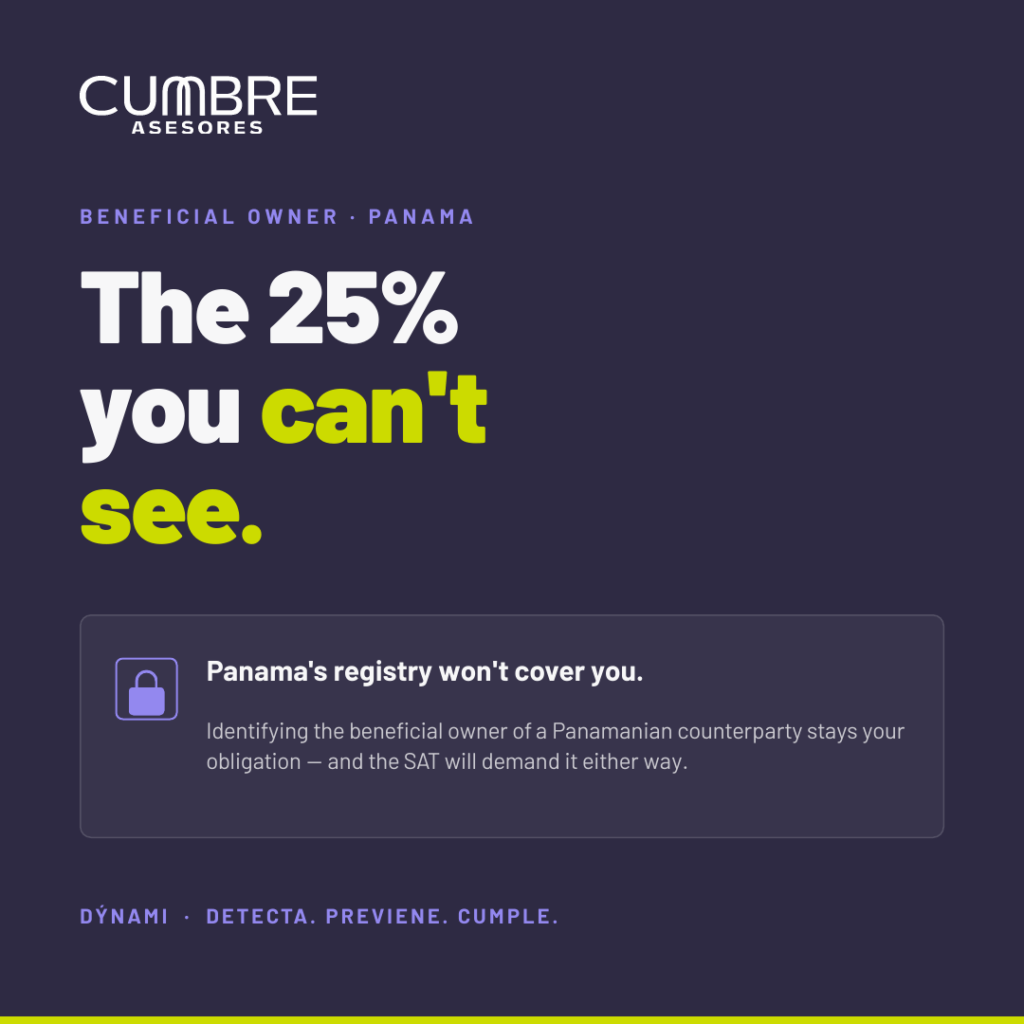
Many companies assume that if their counterparty is in Panama, beneficial owner identification is “already handled” because Panama keeps a beneficial ownership registry. It is a costly mistake. The registry exists, but you cannot access it— it is private and restricted. The obligation to identify the beneficial owner of that Panamanian company still falls on you, and Mexico’s SAT and the UIF will demand it just as if the counterparty were based in Mérida.
This article explains what changes across the border, what does not, and what you have to put in writing before the operation moves forward.
The same 25%, different access
There is a deceptive symmetry between the two countries. Both Mexico and Panama align their definition of beneficial owner with the FATF standard (Recommendation 24) and use the same reference threshold: the individual who, directly or indirectly, holds more than 25% of the capital or voting rights, or who exercises effective control.
The symmetry ends there. In Mexico, you must hold the beneficial owner information yourself, as part of your accounting records, ready to hand to the SAT. In Panama, that information lives in a private, restricted-access system that only Panamanian authorities can reach. The threshold is identical; the ability to verify it from the outside is not.
What Mexico’s CFF requires
Since January 1, 2022, Article 32-B Ter of the CFF requires legal entities, trusts, and other legal arrangements to obtain, keep, and maintain up to date reliable information on their beneficial owners, and to provide it to the SAT on request. Article 32-B Quáter defines who that beneficial owner is (participation above 25%, de facto control, or economic benefit), and 32-B Quinquies sets the subsidiary criteria for when no individual can be identified.
This is not a filing you submit and forget. The obligation is permanent and self-executing: the SAT can find a deficient file during an audit without ever having requested anything from you first. And the penalties under Articles 84-M and 84-N apply per beneficial owner — from MXN 1,500,000 to 2,000,000 for failing to obtain, keep, or present the file, and from MXN 800,000 to 1,000,000 for failing to keep it updated — on top of turning your certificate of tax compliance(opinión de cumplimiento, Art. 32-D) negative.
In parallel, if you carry out vulnerable activities, the LFPIORPI (Mexico’s AML law) requires you to identify your client’s beneficial owner — a definition reformed in the Federal Official Gazette on July 16, 2025, with regulations published on March 27, 2026. Two distinct obligations coexist: one fiscal (CFF), one anti-money-laundering (LFPIORPI), and both point to the same individual behind the structure.
Panama’s registry is private
Law 23 of 2015 established Panama’s AML framework and the beneficial owner figure; Law 129 of 2020 created the Private and Unique Registry of Beneficial Owners, administered by the Superintendency of Non-Financial Subjects (SSNF). It is the resident agents — the lawyers or firms that service the company — who load and update that data.
The key point for you: this registry is not publicly accessible. The information is strictly confidential and can only be disclosed by the SSNF to competent Panamanian authorities for specific proceedings. As a Mexican obligated party, you have no way to query it to cross-check your counterparty’s beneficial owner. The registry’s existence is not your compliance.
The burden stays with you
Here is the crux: the opacity on the other side of the border does not reduce your obligation — it aggravates it. If you cannot rely on a public registry, you have to build the identification through your own due diligence: incorporation deeds, the chain of shareholding, attorneys-in-fact, valid powers of attorney, and a traceable record of how you reached the individual who controls or benefits. And doing it once is not enough — a shareholder can change, take public office (becoming a PEP), or appear on a restrictive list tomorrow.
This is precisely the gap that DÝNAMI by Cumbre Asesores closes. Instead of leaving beneficial owner information trapped in isolated deeds and PDFs, DÝNAMI turns it into a structured, auditable database: you register each individual once — shareholder, attorney-in-fact, real beneficial owner — and the platform links them, in satellite mode, to everycompany and subsidiary where they hold a stake. Its mapping of corporate structures and networks of partners and PEPs lets you reconstruct the effective control of a Panamanian counterparty even when its registry is closed, and submit every exception to an immutable approval log. If a beneficial owner enters a list or becomes a PEP, the alert fires across all linked accounts at once. It is the difference between saying you identified the real owner and being able to prove it to the SAT or GAFILAT.
The group’s cascade risk
Panamanian structures are rarely a single company: they tend to chain into holdings and subsidiaries, precisely to dilute the visibility of control. Isolated analysis fails there. You need the 360° environment: whether a shareholder of one subsidiary is also a supplier to another company in the same group, whether there is fund triangulation or simulated transactions. DÝNAMI’s tree view groups accounts under holding and subsidiary and analyzes cascade risk — which is exactly where the problem the SAT eventually finds tends to hide.
How to secure the identification
Four concrete steps if you operate with Panamanian counterparties:
- Reconstruct the chain of control down to the individual — don’t stop at the corporate name or assume Panama’s registry “already has it.”
- Document the path: keep the evidence of how you identified the beneficial owner. Without evidence, for the SAT’s purposes, you did not identify them.
- Monitor continuously, not just at onboarding. Control and lists change.
- Map the full group, not the standalone entity, to catch cascade risk.
Frequently asked questions
Can I request my counterparty’s beneficial owner data from Panama’s registry?
No. The Private and Unique Registry of Beneficial Owners (Law 129 of 2020) is restricted-access; only competent Panamanian authorities reach it through the SSNF. You must build the identification yourself.
If my Panamanian counterparty is already listed in that registry, am I automatically compliant in Mexico?
No. That registration is a Panamanian obligation of its resident agent. Your obligation under the CFF (32-B Ter) and, where applicable, the LFPIORPI, is independent and still falls on you.
What ownership threshold defines the beneficial owner?
More than 25% of the capital or voting rights, directly or indirectly; also whoever exercises de facto control or receives the economic benefit, even if they do not appear on paper.
What penalties apply if I fail to identify the beneficial owner?
Under CFF Articles 84-M and 84-N, from MXN 1,500,000 to 2,000,000 per beneficial owner not obtained, kept, or presented, plus a negative certificate of tax compliance. The LFPIORPI provides for additional penalties in vulnerable activities.
This content is informational and does not constitute legal or tax advice for a specific case. The application of the CFF, the LFPIORPI, and Panamanian regulations depends on the circumstances of each operation.